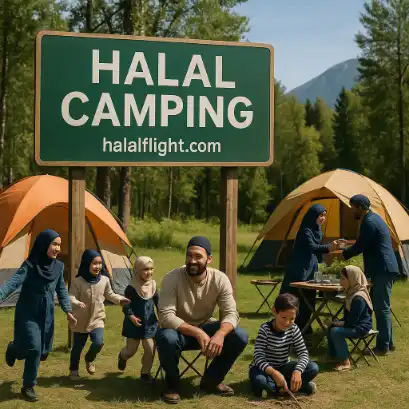
HALAL CAMPING FOR MUSLIM
A halal camping stay is not just a tent in a beautiful landscape or a cabin in the woods. The difference lies in the operating model: halal food that is actually controlled, a clear alcohol policy, privacy for families, and honest information about whether leisure areas are mixed, private-hire, or women-only. Nature by itself does not make a campsite Muslim-friendly.
The real role of camping is simplicity, retreat, and closeness to nature, but halal travel adds extra requirements
Camping is usually chosen for calm, fresh air, outdoor activities, and a less commercial atmosphere than a city hotel or beach resort. In a halal context, that same format can work very well for families and couples because cabins, domes, desert tents, and bungalows often offer more privacy than standard hotel rooms. But the smaller format also means separate facilities and formal prayer spaces are not always available.
What makes a camping resort truly Muslim-friendly and not just nature-based
A genuinely Muslim-friendly camping resort usually makes its faith-conscious features visible: whether all food is halal, whether alcohol is banned completely or only removed from rooms, whether modest swimwear is allowed, and whether family privacy is built into pools, hot tubs, cabins, or spa access. If a property only offers a forest view and a quiet atmosphere, that still does not prove halal compliance.
Full halal compliance is much stricter than partial halal camping
The strongest version of halal camping means all food served on the property is halal and no alcohol is served anywhere on site. A partial option may still be useful, but it often means only some food is halal, halal food is merely available nearby, or alcohol may still be served in the wider property while being removed from the guest room. That distinction matters more than the marketing label.
Private family space is one of the biggest strengths of halal camping and glamping
Many Muslim travelers choose camping-style accommodation not because it is basic, but because it can offer detached units, private terraces, and in some cases secluded pools or hot tubs. Properties such as dome suites, bungalows, and thermal residences can give families a much more controlled environment than a conventional resort corridor or busy hotel wing.
Gender-segregated facilities do exist, but they are concentrated in selected countries and selected properties
Separate women-only and family facilities are possible, but they are not standard across the camping segment. Türkiye stands out because some halal-conscious bungalow and holiday village properties explicitly advertise women-only pools, female staff only in those areas, or separated wellness centres. In simpler desert camps and glamping sites, those features are often absent even when the property is fully halal in food and alcohol terms.
Halal food and alcohol-free environments are not guaranteed unless the listing says so explicitly
Some camps clearly state “all food halal” and “no alcohol served anywhere,” while others only show “halal-friendliness data pending” or say alcohol can be removed from rooms if booked through a halal travel platform. That means travelers should not assume anything from the country alone, even in Muslim-majority destinations. The property-level statement is what counts.
Prayer areas, Qibla direction, and nearby mosques are helpful, but they are not universal defaults
Some halal-oriented properties explicitly mention prayer and ablution facilities, while many others say nothing at all. In practice, a Muslim-friendly camping resort may be excellent on food and privacy but still offer no dedicated prayer room. That is why travelers should check three separate points before booking: on-site prayer facilities, Qibla guidance, and whether the nearest mosque is practical by car or on foot.
The strongest Muslim-friendly camping destinations today are Türkiye, Oman, Saudi Arabia, Morocco, Tunisia, and the Gulf
Those destinations currently show the most visible mix of alcohol-free operation, halal-only food, desert camps, bungalows, thermal villages, and privacy-focused leisure. By contrast, camping in Europe and North America is more likely to be partial halal, where the main advantages are detached accommodation and access to halal food nearby rather than fully segregated infrastructure or all-halal on-site operations.
Price and suitability depend on privacy level, catering quality, and whether the stay is basic camping or luxury glamping
Muslim-friendly camping can cost close to ordinary mid-range travel when it is a simple bungalow or desert camp, but secluded pools, thermal suites, and premium glamping raise prices quickly. In the current listings surfaced here, examples range from around €76 for a basic halal bungalow in Türkiye to around €139 for desert camps in Oman, €208 for luxury desert glamping in Morocco, €280 for partial halal glamping in Türkiye, and €640 for a high-end desert retreat in Saudi Arabia. That also explains why halal camping can work for both budget family breaks and honeymoon-style escapes.
How to verify full halal compliance before booking any camping resort
The safest method is to check the property page for five exact items: whether all food is halal, whether alcohol is banned everywhere, whether pools or spas are women-only, mixed, or private-hire, whether privacy is fully secluded or only partial, and whether prayer facilities are actually listed. If even one of those points is vague, treat the property as partial until the host confirms the details in writing.
Global list of halal camping, glamping, bungalow, and desert-camp style stays
Below, Full means the property page explicitly shows halal food and no alcohol on site. Partial means the property page shows limited halal support, alcohol removal from rooms only, some halal food, or pending/incomplete data.
HALAL CAMPING & GLAMPING LIST (COUNTRY → CITY → PROPERTY)
Oman
- Bidiya — Sama Al Wasil Desert Camp
Halal level: ✅ Full
Conditions: All food halal
Criteria: No alcohol served anywhere, traditional desert camp, no segregated spa
Link: https://halalbooking.com/en/sama-al-wasil-desert-camp/p/165439 - Bidiya — Luxury Desert Camp Oman
Halal level: ⚠️ Partial
Conditions: Halal-friendly environment
Criteria: Halal compliance not fully confirmed
Link: https://halalbooking.com/en/luxury-desert-camp-oman/p/506821
Saudi Arabia
- AlUla — Our Habitas AlUla
Halal level: ✅ Full
Conditions: All food halal
Criteria: Alcohol-free, luxury desert retreat, mixed leisure areas
Link: https://halalbooking.com/en/our-habitas-alula/p/505975 - AlUla — Banyan Tree AlUla
Halal level: ✅ Full
Conditions: Halal food guaranteed
Criteria: No alcohol, private villas with secluded pools
Link: https://halalbooking.com/en/banyan-tree-alula/p/506860
Morocco
- Agafay (Marrakech region) — Agafay Luxury Camp
Halal level: ⚠️ Partial
Conditions: Halal-friendly services
Criteria: Alcohol policy unclear, verify before booking
Link: https://halalbooking.com/en/agafay-luxury-camp/p/506469
Indonesia
- Bintan — The ANMON Resort Bintan (Glamping)
Halal level: ⚠️ Partial
Conditions: Halal-friendly environment
Criteria: Halal compliance not fully documented
Link: https://halalbooking.com/en/the-anmon-resort-bintan-glamping/p/423978
Spain
- Blanes (Barcelona region) — Camping La Masia
Halal level: ⚠️ Partial
Conditions: Halal food nearby
Criteria: Alcohol present, can be removed from room
Link: https://halalbooking.com/en/camping-la-masia/p/317889
United Kingdom
- Southwell — Southwell Retreat Glamping Pods
Halal level: ⚠️ Partial
Conditions: Halal-friendly stay
Criteria: No confirmed alcohol-free policy
Link: https://halalbooking.com/en/southwell-retreat-glamping-pods/p/371371 - Carnforth — Keer Side Lodge (Pine Lake Resort)
Halal level: ⚠️ Partial
Conditions: Halal food possible
Criteria: Alcohol present in resort
Link: https://halalbooking.com/en/keer-side-lodge-luxury-lodge-with-private-hot-tub-at-pine-lake-resort/p/152839
Turkey
- Alanya — Sedir Park Bungalow
Halal level: ✅ Full
Conditions: All food halal
Criteria: No alcohol, women-only secluded pool
Link: https://halalbooking.com/en/sedir-park-bungalow/p/1239 - Abant — Abant Sedir Park
Halal level: ✅ Full
Conditions: Halal food only
Criteria: Alcohol-free, private jacuzzi options
Link: https://halalbooking.com/en/abant-sedir-park/p/503975 - Sapanca — Casamia Suit
Halal level: ✅ Full
Conditions: Halal food
Criteria: Alcohol-free, private suites
Link: https://halalbooking.com/en/sapanca-casamia-suit/p/530852 - Afyonkarahisar — Aforia Thermal Residences
Halal level: ✅ Full
Conditions: Halal-certified
Criteria: No alcohol, private pools, prayer facilities
Link: https://halalbooking.com/en/aforia-thermal-residences/p/3923 - Kalkan — Kalkan Dome Suites
Halal level: ✅ Full
Conditions: Halal food
Criteria: No alcohol, fully secluded pools
Link: https://halalbooking.com/en/kalkan-dome-suites-deluxe/p/607398 - Fethiye — Fullmoon Camping
Halal level: ⚠️ Partial
Conditions: Halal food
Criteria: Alcohol removed from rooms only
Link: https://halalbooking.com/en/fullmoon-camping/p/492060
Egypt
- Giza — Squad 101 Retreat Camp
Halal level: ✅ Full
Conditions: Halal food only
Criteria: Alcohol-free, private spa available
Link: https://halalbooking.com/en/squad-101-world-class-military-themed-fitness-weight-loss-boot-camp-retreat-hotel/p/347873
- Halal flights the guide for airlines with in-flight sharia compliant food
- Islamic Tourism
- Halal Beach
- Halal Bed And Breakfast
- Halal Camping
- Halal Cruise
- Islamic Honeymoon
- Halal Luxury Holidays
- Luxury Halal Restaurant
- Islamic Car Sharing
- Islamic Ski Resort
- Halal Spa
- Halal Travel Agency
- Islamic Travel Insurance
- Halal Weekend
- Ramadan Holidays
- Vacation Club
- UK Halal Hotel
- USA Halal Hotel
- Umrah Price Comparator
- Halal Swimming Pool
- Halal flights the guide for airlines with in-flight sharia compliant food